
About Chiddingly Parish Bonfire Society
Chiddingly Parish Bonfire Society (CPBS) is a relatively young society with roots in a much older local bonfire tradition. The present society was founded in October 2020 and has quickly established a distinctive identity based firmly around the history and character of Chiddingly.
Since its formation, CPBS has grown considerably, representing the parish at celebrations across Sussex and Kent as well as staging its own annual procession, bonfire and fireworks in Chiddingly.
Although the modern society dates from 2020, Bonfire in Chiddingly is nothing new. Records show that an earlier Chiddingly Bonfire Boys organisation was established in the village, with celebrations documented in 1912.
The Chiddingly Boar
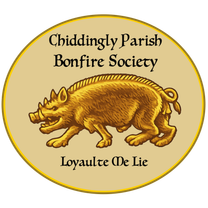
Perhaps the most interesting part of Chiddingly’s identity is the wild boar that appears on the society’s emblem.
This is not simply an animal chosen to make a memorable badge. It has a remarkable connection with the village.
In 1999, a late fifteenth-century silver livery badge depicting a boar was discovered in the parish of Chiddingly. Dating from the 1480s, it is associated with a supporter of King Richard III, for whom the white boar was an important personal emblem.
When the modern Bonfire Society was established in 2020, the discovery provided it with an ideal symbol. The society adopted a reclining wild boar together with Richard III's motto, “Loyaulté me lie” – “Loyalty binds me.”
The boar has since become central to Chiddingly’s identity.
The Pig Army
The boar connection has even given Chiddingly members their own nickname: the “Pig Army.”
Surprisingly, this tradition is extremely recent.
It began during the society's first visit to Hastings Bonfire in October 2022. Member Roz Bassford was dressed in her agricultural Pioneer costume as a “Pig Woman” when other members called out “Pig Woman!” Her reply of “Pig Army!” quickly developed into a chant that followed the society through the streets of Hastings.
The name stuck.
The society also processes with a wild boar's head affectionately known as Piggy Sue, further strengthening what has become one of CPBS's most recognisable traditions.
The First Pioneers – Agricultural Workers
Chiddingly’s First Pioneers are pre-1950s agricultural workers, a choice firmly connected to the history of the parish.
For generations, farming and associated rural trades were central to life in Chiddingly and the surrounding countryside. Rather than representing one narrowly defined group, the Pioneer theme celebrates the many people who would once have made their living from the land.
Members can therefore appear as farm labourers, hop pickers, milkmaids, millers, blacksmiths, farriers, gamekeepers, poultry workers and other rural characters. Women's Land Army dress is also included.
It makes the Pioneer group particularly varied while retaining a genuine connection with Chiddingly's agricultural past.
The society's colours are equally distinctive, with its smugglers wearing light blue, dark blue and gold striped guernseys.
Richard III and the Second Pioneers
The discovery of the Chiddingly Boar also inspired the society's Second Pioneer group – the Followers of Richard III.
Their dress represents Yorkist supporters during the Wars of the Roses in the late fifteenth century, directly reflecting the period from which the Chiddingly Boar originates.
Members use medieval clothing, armour and heraldic symbols associated with Richard III and the House of York. Burgundy and dark blue feature prominently, while the white boar and Yorkist rose provide further connections with the King.
It is an unusually local reason for choosing a Pioneer group: the costume effectively brings to life the story behind an archaeological object actually discovered within the parish.
Plague Doctors
Chiddingly even has a Third Pioneer group – Plague Doctors.
These members represent the practitioners and supposed healers associated with outbreaks of plague during the Renaissance and Restoration periods.
Their dramatic black clothing, long coats and distinctive masks make the Plague Doctors one of Chiddingly’s most theatrical groups and provide a striking contrast with the agricultural workers and medieval followers of Richard III.
Old Clem and Chiddingly's Ironworking Heritage
Another particularly local feature of Chiddingly Bonfire is its connection with St Clement, traditionally regarded as the patron saint of blacksmiths.
Ironworking has a long history around Chiddingly, making St Clement – or Old Clem – an appropriate figure to incorporate into the village celebrations.
This connection became especially significant in 2024, when Chiddingly's Bonfire Night fell on 23 November, St Clement's Day. The society produced a special badge featuring an anvil and the words “Health to the Jolly Blacksmith,” taken from the traditional blacksmiths' song Twankie Dillo.
It is another example of CPBS taking elements of Chiddingly's own history and incorporating them into the society rather than simply borrowing traditions from elsewhere.
A Village with an Important Bonfire Connection
Chiddingly also has an interesting connection with the development of Bonfire traditions elsewhere in Sussex through Mark Antony Lower, who was born in the village in 1813.
Lower became a prominent Sussex historian and was one of the founders of the Sussex Archaeological Society. In 1851 he published The Sussex Martyrs, helping revive nineteenth-century interest in the Protestant martyrs executed during the reign of Mary I.
The society's own history notes the influence Lower's work had on renewed interest in the martyrs during the 1850s, shortly before organised bonfire societies began appearing in Lewes and elsewhere.
It gives Chiddingly an intriguing connection with the development of the traditions that later spread throughout the county.
Community and Membership
Despite all this history, Chiddingly Parish Bonfire Society remains very much a modern community organisation.
The society was established in 2020 with the aim of creating something positive for Chiddingly and the surrounding community. It has since grown rapidly, attracting members and developing its own traditions in only a few years.
Members take part in celebrations elsewhere during the season as well as helping organise Chiddingly's own event towards the end of November.
Fundraising is essential. The society organises events including its Summer Fayre and Dog Show, while donations and other fundraising help meet the increasing cost of staging the annual celebrations.
Keeping Chiddingly's Tradition Alive
Chiddingly Parish Bonfire Society is an interesting example of how a new society can create its own identity by looking closely at the history of the place it represents.
Founded only in 2020, CPBS has drawn inspiration from an earlier generation of Chiddingly Bonfire Boys while creating traditions firmly rooted in the parish.
Its agricultural workers celebrate Chiddingly's rural heritage; the Followers of Richard III tell the story of the medieval boar badge discovered in the village; and the Old Clem traditions recognise the area's connections with blacksmithing and ironworking.
Add the blue-and-gold stripes, Plague Doctors, Piggy Sue and the cries of “Pig Army!”, and Chiddingly has developed an unmistakable character of its own.
In only a few years, Chiddingly Parish Bonfire Society has successfully revived an older village tradition while creating something that feels distinctly and unmistakably Chiddingly.